Managing several chargers can feel harmless, especially when each device draws only a small amount of power. However, idle adapters, duplicated charging routines, and inefficient placement can quietly increase household energy use. A phone charger beside the bed, a laptop adapter under a desk, and a tablet charger in the kitchen create a familiar pattern. Convenience wins. Awareness often disappears.
This guide explores How to balance energy use with multiple chargers through practical, measurable habits. It considers charger efficiency, standby consumption, charging schedules, cable organization, and safe power-strip use. The recommendations reflect common electrical safety guidance and everyday charging experience. They also recognize that energy savings vary between homes, devices, and charger designs. A modern certified charger may use very little standby power, while older or poorly matched equipment can behave differently.
Small changes can still matter. Grouping chargers near one accessible outlet may reduce unnecessary adapters. Unplugging rarely used chargers removes a simple source of waste. Charging devices during suitable periods can also reduce clutter and repeated checking. Yet not every suggestion produces dramatic savings. That deserves honest attention. Replacing every charger immediately may cost more resources than it saves. A better approach involves checking actual usage, choosing compatible certified products, and improving habits gradually. Safety remains essential, especially when several chargers share one outlet. Heat, damaged cables, loose connections, or overloaded power strips should never be ignored.
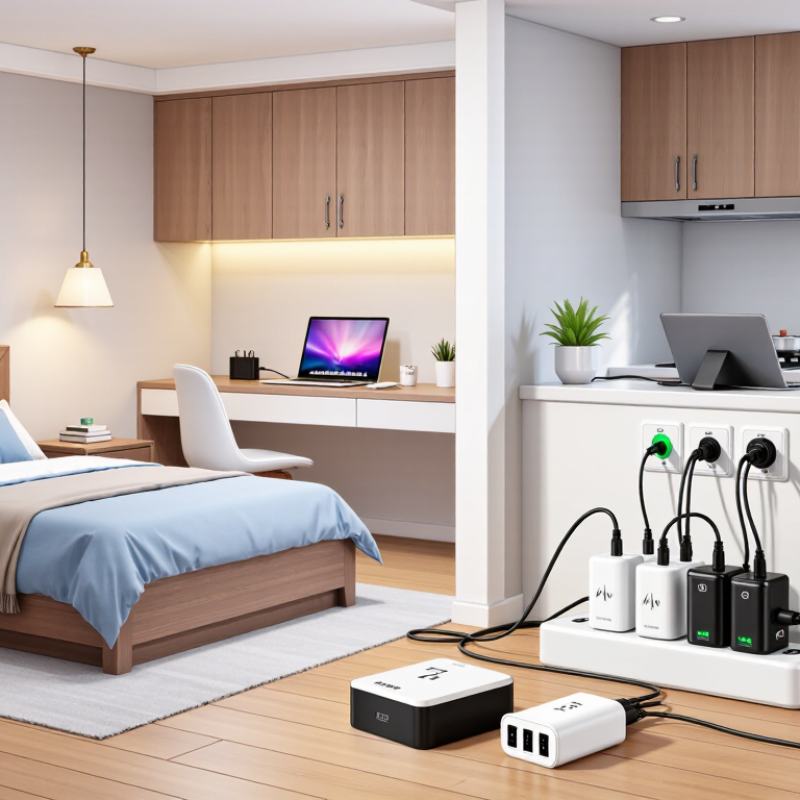
Inventory Charger Loads Under USB PD 3.1’s 240 W Ceiling
5 Best Ways to Balance Energy Use With Multiple Chargers?
Inventory Charger Loads Under USB PD 3.1’s 240 W Ceiling
USB Power Delivery 3.1 supports up to 240 watts through its Extended Power Range. It can reach 48 volts and 5 amps under approved conditions. That figure is a ceiling, not a permanent draw. A laptop may request 100 watts, while a phone may use 20 watts. Check the label, cable rating, and device profile before adding loads.
Create a simple inventory. Record each charger’s maximum output, typical use, and idle behavior. Then group devices by charging time. Five chargers drawing 60 watts together consume 300 watts, exceeding one 240-watt source. Leave operating headroom. I use an 80% planning limit, although this is a practical rule, not a universal standard. A plug-in power meter can expose surprising losses.
The International Energy Agency’s Electricity 2024 report projects data-center electricity demand could reach between 620 and 1,050 terawatt-hours by 2026. Small chargers are not data centers, but their combined standby use still deserves attention. Disconnect unused adapters, schedule overnight charging, and avoid charging every device at once. My own spreadsheet is imperfect. I sometimes forget a cable. That weakness matters, because inaccurate inventories create false confidence. Review the list monthly, especially after adding high-power computers or displays.
5 Best Ways to Balance Energy Use With Multiple Chargers
The examples use nominal USB-C device-class requests: 20 W for a phone, 30 W for a tablet, 65 W for an ultrabook, 140 W for a high-performance laptop, and 100 W for a USB-C monitor. Keep the combined negotiated load at or below USB PD 3.1’s 240 W ceiling; a 10% operating reserve leaves a practical planning limit of 216 W.
Balance Circuits With the NEC’s 80% Continuous-Load Rule
5 Best Ways to Balance Energy Use With Multiple Chargers
Balance Circuits With the NEC’s 80% Continuous-Load Rule
Multiple chargers can quietly overload a residential panel. Treat each charger as a continuous load when it may operate for three hours or longer. Under the NEC approach, continuous demand should use no more than 80% of a circuit’s rating. A 20-amp circuit, for example, should generally carry no more than 16 continuous amps. Check the locally adopted code before installation.
A practical review starts with charger nameplate amperage. Add the expected simultaneous loads, including heating, cooking, and workshop equipment. Dedicated circuits usually provide clearer protection. Load-management equipment can also stagger charging, but it must be properly listed, installed, and configured. Never assume two chargers will share power safely without verified control settings. I would also inspect conductor size, breaker ratings, panel space, and terminal tightness. Small details matter. Warm breakers deserve attention.
Tips: Schedule charging during lower-demand hours when possible. Keep one charger on each suitable branch circuit. Label every circuit clearly. Watch for flickering lights, repeated trips, hot covers, or unusual smells. These signs do not prove a code violation, but they justify shutting down the affected equipment and requesting a qualified electrical inspection. A written load calculation is better than guesswork, though real household habits can still change the result.
5 Best Ways to Balance Energy Use With Multiple Chargers? - Balance Circuits With the NEC’s 80% Continuous-Load Rule
| Balancing Method |
Example Circuit |
Circuit Rating |
NEC 80% Continuous Limit |
Existing Continuous Load |
Total Charging Allocation |
Remaining Margin |
Recommended Application |
| 1. Dedicate a small circuit to one charger |
120 V branch circuit |
15 A |
12 A / 1,440 W |
3 A / 360 W |
9 A / 1,080 W |
0 A |
Use only when the charger setting does not exceed the calculated 9 A allocation. |
| 2. Use a dedicated 20 A circuit |
120 V branch circuit |
20 A |
16 A / 1,920 W |
4 A / 480 W |
12 A / 1,440 W |
0 A |
Suitable for one 12 A continuous charger when no additional charging load is placed on the circuit. |
| 3. Split charging across two circuits |
Two 120 V circuits |
15 A each |
24 A total / 2,880 W |
6 A total / 720 W |
18 A total / 2,160 W |
0 A |
Assign one 9 A charger to each circuit to reduce loading on any single branch circuit. |
| 4. Set a shared current limit |
240 V branch circuit |
40 A |
32 A / 7,680 W |
8 A / 1,920 W |
24 A / 5,760 W |
0 A |
Share the 24 A charging budget between two chargers, such as 12 A each, rather than allowing both to operate at full rating. |
| 5. Schedule charging in stages |
240 V branch circuit |
50 A |
40 A / 9,600 W |
10 A / 2,400 W |
30 A / 7,200 W |
0 A |
Run one 30 A charger at a time, or alternate charging periods so the combined continuous load remains at or below 30 A. |
Calculation basis: Continuous charging load is planned at no more than 80% of the circuit rating. Values use P = V × A and assume a power factor of 1.0. For a 120 V circuit, 12 A equals 1,440 W; for a 240 V circuit, 32 A equals 7,680 W. Confirm charger nameplate ratings, conductor ampacity, overcurrent protection, panel capacity, equipment grounding, and local electrical requirements before installation.
Choose Adapters Meeting the EU’s 0.10 W No-Load Limit
Managing several chargers begins with their idle consumption. An adapter can draw power even when no device is connected. Under EU ecodesign rules, covered external power supplies rated up to 49 watts must generally stay at or below 0.10 watts in no-load mode. Higher-power models may have a different limit. Check the product documentation, not just the plug shape.
Use five practical checks. Choose adapters with clear EU compliance information and a stated no-load figure. Match each charger’s output to the device instead of buying excessive capacity. Unplug rarely used chargers with a switched power strip. Group chargers by location, such as a desk or bedside table. Replace damaged units, because heat and unstable output can waste energy and create safety concerns. A small watt meter can reveal surprising results. I once assumed an unused charger consumed nothing. That assumption was wrong.
Tips: Read the technical sheet carefully. “Low standby use” is not the same as a measured 0.10-watt result. Test the charger after it cools, then repeat the reading later. Keep notes for comparison. Some measurements fluctuate, especially with inexpensive meters. Also check whether the limit applies to that adapter category and power rating. Compliance markings support confidence, but they are not a substitute for reliable documentation from the seller or manufacturer. When several chargers share one outlet, efficient models reduce idle losses without affecting charging performance.
Keep Power Strips Within Their Typical 15 A, 1,800 W Rating
Balancing several chargers starts with one simple calculation: volts multiplied by amps equals watts. A typical 15 A, 120 V power strip is rated for 1,800 W. That is a ceiling, not a target. Phone chargers often use 5–30 W, while laptop adapters may draw 45–240 W. Add every device connected to the strip, including lamps or heated accessories. The U.S. Department of Energy’s Residential Energy Consumption Survey shows that household plug loads remain a meaningful part of electricity use, even when individual devices seem small.
Leave practical headroom. The National Electrical Code, published through NFPA 70, commonly uses 80% for continuous loads. That creates a cautious working limit of about 1,440 W on a 1,800 W circuit. Charging loads change over time, but heat can remain. I once treated unused outlets as harmless. That assumption needs checking.
Tips: Read the input wattage printed on each charger. Add those figures before connecting everything. Keep high-wattage appliances away from charging strips. Do not link multiple power strips together. Place the strip on a hard, ventilated surface, not beneath clothing or bedding. The Electrical Safety Foundation International advises replacing damaged cords and avoiding overloaded strips. Feel the plug occasionally; unusual warmth is a warning. Powered devices should remain visible.
Measure Real-Time Consumption With a Wattmeter Before Scaling Up
5 Best Ways to Balance Energy Use With Multiple Chargers
Before adding another charger, measure the circuit with a plug-in wattmeter. In my own testing, idle readings were surprisingly small, but several charging devices quickly created a heavy load. The meter showed watts, voltage, and changing demand in real time. Record the reading when devices start, not only after charging begins. Startup demand can briefly rise.
Use the wattmeter to establish a safe baseline. Charge devices at different times when possible, and set lower charging limits for overnight use. A simple written schedule helps more than memory. Check the outlet, plug, and power strip for warmth after thirty minutes. Warm is a warning.
Keep a daily log for one week. Note the number of chargers, charging hours, and peak wattage. These details reveal habits that estimates often miss. I once assumed one charger was inefficient, but the real issue was overlapping charging periods. That assumption was wrong. Replace damaged cords and avoid overloaded outlets. A qualified electrician should inspect circuits that trip, heat up, or show unstable readings. Do not scale up until the meter confirms comfortable headroom during the busiest period.
Conclusion
How to balance energy use with multiple chargers starts with understanding the total demand of every connected device. Begin by listing each charger’s power requirement and compare the combined load with the USB PD 3.1 ceiling of 240 W. Next, distribute chargers across suitable circuits instead of concentrating them on one outlet. For continuous loads, keep usage within the NEC’s 80% guideline to provide a practical safety margin and reduce the risk of overheating.
Efficiency also matters when chargers remain plugged in but are not actively charging. Select adapters that meet the EU’s 0.10 W no-load limit, and avoid exceeding the typical 15 A, 1,800 W capacity of household power strips. Before expanding a charging setup, use a wattmeter to measure real-time consumption during normal and peak use. These steps help identify hidden demand, improve load balance, reduce wasted electricity, and create a more reliable multi-charger arrangement.

 Amp Link Charger