Understanding electric vehicle charging can be overwhelming. Many drivers wonder, "What is the difference between level 1 and level 2 chargers?" This distinction impacts efficiency, cost, and convenience. Level 1 chargers use a standard 120-volt outlet, making them widely accessible. They are simple and safe, but the charging time can be lengthy. A full charge may take up to 20 hours for some vehicles.
In contrast, level 2 chargers operate on a 240-volt outlet. They are faster and more efficient, often charging a vehicle in just a few hours. While they require professional installation, the benefits can outweigh the costs. Drivers seeking convenience and faster turnaround times may prefer level 2 options.
Ultimately, the choice between these chargers depends on individual needs. Some might opt for level 1 due to initial affordability. Others, however, might find the speed of level 2 chargers worth the investment. Understanding these differences is key to making informed decisions for electric vehicle ownership.
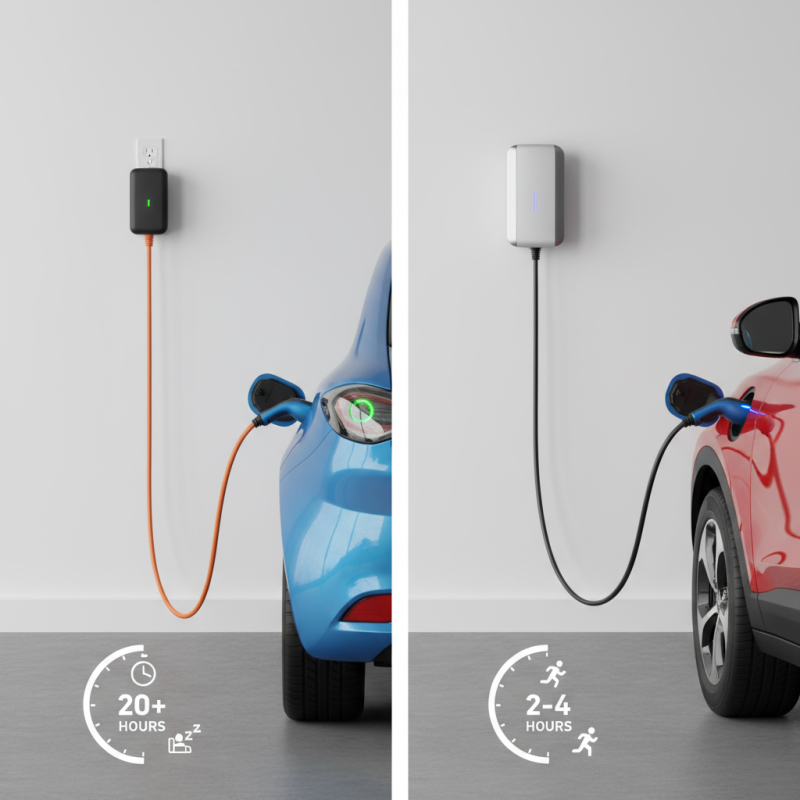
What Are Level 1 Chargers and Their Key Characteristics?
Level 1 chargers are the most basic type of electric vehicle (EV) charging solution. They connect to a standard household outlet and provide a slow charging rate. Typically, these chargers deliver 120 volts and can take several hours or even overnight to fully charge an EV. Because of their simplicity, Level 1 chargers are often used for home charging. They are ideal for those who drive short distances daily.
One key characteristic of Level 1 chargers is their low installation cost. You often don't need any special equipment or wiring. However, they are not suitable for all users. Drivers with longer commutes may find them insufficient. While convenient for overnight charging, they lack the speed that many users desire.
Tips: If you have a short daily commute, a Level 1 charger might work well for you. Always check your EV's battery capacity to gauge charging time. A longer charge time could mean slower daily readiness. It's important to consider your travel habits before committing to a charging solution. Be aware of the time you'll need for a full charge, and adjust your usage accordingly.
Understanding Level 2 Chargers and Their Unique Features
As electric vehicle (EV) adoption rises, understanding charging options is crucial.
Level 2 chargers offer unique features that set them apart from Level 1 chargers.
They typically operate at 240 volts and can deliver up to 32 amps. This means they can provide a full charge to most EVs in a matter of hours, rather than overnight, as is common with Level 1 chargers.
Level 2 chargers also support various charging speeds. According to a recent industry report from the Electric Vehicle Infrastructure Projection,
they can add between 10 to 60 miles of range per hour, based on the vehicle model and charger specifications.
This flexibility is advantageous for urban environments, where quick charging is often necessary.
Furthermore, many Level 2 models come with features like Wi-Fi connectivity, allowing users to monitor their charging status remotely.
Tips: When considering a Level 2 charger, check installation requirements.
Professional installation may be necessary to ensure optimal performance. Also, consider potential energy costs.
While Level 2 chargers are efficient, electric rates can vary significantly.
Additionally, think about the location of installation. A convenient spot can greatly enhance your charging experience.
Some users might find it helpful to investigate local incentives or rebates for installing residential chargers.
This can offset some costs and make going electric more accessible.
Comparing Charging Speeds: Level 1 vs. Level 2
When comparing Level 1 and Level 2 electric vehicle chargers, the charging speed stands out.
Level 1 chargers typically deliver 1.4 kW to 1.9 kW.
This translates to about 4-5 miles of range per hour. For most electric vehicle (EV) owners, this means overnight charging is essential.
Considering the average daily commute, this speed often suffices for urban drivers. However, it's not ideal for those who need quicker turnaround times.
In contrast, Level 2 chargers provide more robust charging capabilities, generally ranging from 3.3 kW to 19.2 kW.
This results in charging speeds that can restore 10 to 60 miles of range per hour. A report from the U.S. Department of Energy indicates that Level 2 charging is vital for reducing charging time in commercial and public settings.
Fast charging infrastructure can improve overall EV adoption by addressing range anxiety.
Despite the clear advantages of Level 2 chargers, installation costs can be a barrier for some. While they provide faster service, the installation may require
electrical upgrades at home. Many homeowners find it challenging to navigate these requirements. Therefore, while charging speed is crucial,
the context of usage and installation remains a point for further consideration and reflection.
Installation Requirements for Level 1 and Level 2 Chargers
When considering the installation of Level 1 and Level 2 chargers, several factors come into play. Level 1 chargers typically use a standard household outlet. This makes installation quite simple, as no special wiring is necessary. You can plug it in and start charging. However, this also means slower charging speeds, usually around 4 to 5 miles of range per hour.
On the other hand, Level 2 chargers require more attention. They need a dedicated circuit and a higher voltage outlet. This means hiring a qualified electrician to ensure proper installation. Depending on your home’s electrical capacity, you may need to upgrade your panel. The installation process can take several hours and may involve significant costs. It's crucial to consider your home’s layout and existing infrastructure.
While Level 2 offers greater charging efficiency, the installation can pose challenges. Homeowners must assess their budget and electrical capacity carefully. It's easy to overlook these factors, leading to unexpected expenses down the line. Reflecting on your usage patterns is vital. Do you often charge overnight? Or do you require faster charging during the day? This consideration will guide your choice between the two levels.
Cost Analysis: Level 1 vs. Level 2 Chargers and Their Installation
When considering electric vehicle (EV) chargers, cost is a crucial factor. Level 1 chargers typically use standard household outlets, making them low-cost at around $300 to $600. Installation is often as simple as plugging in, but charging speeds are slow. They provide about 4-5 miles of range per hour, which can be insufficient for daily needs.
In contrast, Level 2 chargers offer faster charging. They can deliver 25 miles of range per hour, significantly reducing downtime. However, the cost of these units ranges from $700 to $2,500, not including installation. Installation can also be complex, requiring a dedicated circuit and possibly a breaker upgrade. The total cost, factoring in both the unit and installation, can exceed $5,000 in some cases.
Data shows that many homeowners are realizing the value of faster chargers. According to industry reports, around 30% of new EV buyers opt for Level 2 installations due to their efficiency. This trend reflects growing consumer demand for quicker charging solutions. Yet, the initial investment remains a point of hesitation for some. Balancing the urgency of needs against cost is essential for making the right choice.
FAQS
: Level 1 chargers typically deliver 1.4 kW to 1.9 kW, providing about 4-5 miles of range per hour.
Urban drivers often benefit, as overnight charging usually suffices for daily commutes with this speed.
Level 2 chargers range from 3.3 kW to 19.2 kW, restoring 10 to 60 miles of range per hour.
Level 2 chargers require a dedicated circuit and higher voltage outlets, needing a qualified electrician.
The installation costs can be significant, and they may need electrical upgrades, possibly leading to unexpected expenses.
Level 1 chargers are less expensive, costing around $300 to $600, but they charge slowly.
Level 2 chargers range from $700 to $2,500, and total costs can exceed $5,000 when considering installation.
It's vital to assess if you need overnight charging or faster daytime charging to guide your charger choice.
Many new EV buyers, about 30%, choose Level 2 chargers for their efficiency, driven by growing demand.
Many overlook installation complexities and costs, leading to potential unexpected financial burdens later.
Conclusion
When considering electric vehicle charging options, one common question arises: "What is the difference between level 1 and level 2 chargers?" Level 1 chargers utilize standard household outlets, providing a slower charging speed, which is generally sufficient for overnight charging. They typically deliver around 3 to 5 miles of range per hour of charging. In contrast, Level 2 chargers are designed for faster charging, suitable for home or commercial use, offering a charging rate of 10 to 60 miles per hour, depending on the specific charger and vehicle compatibility.
Installation requirements also vary between the two types; Level 1 chargers are easier to install and usually require minimal electrical upgrades, while Level 2 chargers may necessitate dedicated circuits and potentially higher electrical capacity. Cost is another important factor; Level 2 chargers, while more expensive upfront, can provide significant time savings in charging. Understanding these distinctions helps consumers make informed decisions based on their charging needs and infrastructure capabilities.

 Amp Link Charger